Ved Vyas

Maharishi Ved Vyas, Sage of the Mahabharata

Ved Vyas, also written Veda Vyasa or simply Vyasa, was the sage Krishna Dvaipayana. He is traditionally honoured as the arranger of the four Vedas and the composer of the Mahabharata, and he appears within the epic itself as the grandfather of the Pandavas and Kauravas.

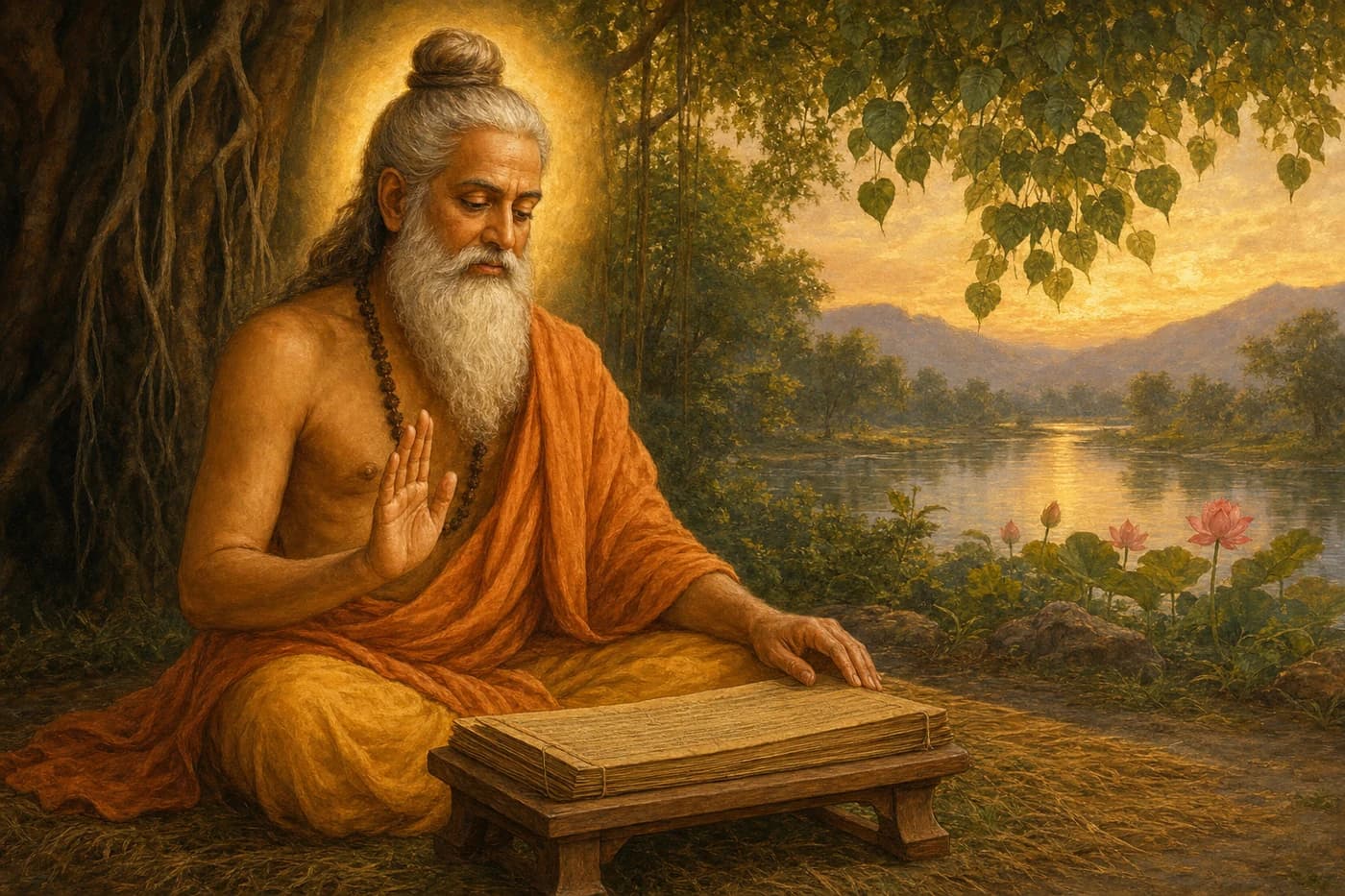
Maharishi Ved Vyas seated beneath a banyan tree at a river hermitage, one hand resting on a palm-leaf manuscript
Maharishi Ved Vyas at his hermitage, arranging the sacred texts. A devotional rendering, not a historical portrait.

Quick facts about Maharishi Ved Vyas

Also known as
Veda Vyasa, Vyasa, Krishna Dvaipayana, Maharishi Ved Vyas
Parents
Parashara and Satyavati
Known for
Dividing the Veda into four
Major works
Mahabharata, Puranas and Brahma Sutras
Family
Grandfather of the Pandavas and Kauravas
Remembered on
Guru Purnima, also called Vyasa Purnima

Who Ved Vyas Was

Ved Vyas was the sage Krishna Dvaipayana, one of the most revered figures in Hindu tradition. He was the son of the sage Parashara and Satyavati, and many accounts regard him as an incarnation or partial incarnation of Vishnu.

His name explains part of his identity. Krishna refers to his dark complexion, while Dvaipayana refers to his traditional birthplace on an island in the Yamuna. Vyasa is a title for one who arranged or divided sacred knowledge.

Why He Is Called Veda Vyasa

The tradition says that sacred knowledge was first held as one Veda. Vyasa arranged it into the Rig, Yajur, Sama and Atharva Vedas so that its teachings could be preserved, studied and passed down through distinct lines.

This act gave him the name Veda Vyasa, the arranger of the Veda. It also explains why Hindu tradition remembers him not only as an author, but as an organizer and teacher of sacred learning.

The Mahabharata and Gita

Ved Vyas traditionally composed the Mahabharata, the great epic about the Kuru family and the conflict that culminates at Kurukshetra. The Bhagavad Gita appears within this epic as the dialogue between Krishna and Arjuna before battle.

Tradition says Ganesha wrote the Mahabharata down while Vyasa dictated it. This account presents the epic as both sacred teaching and carefully transmitted literature, with Vyasa guiding its vast account of duty, kinship and moral choice.

Puranas and Brahma Sutras

Tradition credits Ved Vyas with the eighteen Puranas, a major body of texts that preserves teachings, narratives, genealogies and accounts of the cosmos. His son Shuka is traditionally said to have narrated the Bhagavata Purana.

He is also credited with the Brahma Sutras, a concise work that organizes teachings about Brahman and became foundational to Vedanta. These attributions explain the range of learning associated with Vyasa across Hindu philosophy and sacred literature.

Within the Kuru Family

Ved Vyas is both the composer of the Mahabharata and a character within it. Through the family line described in the epic, he became the father of Dhritarashtra, Pandu and Vidura, and therefore the grandfather of the Kauravas and Pandavas.

His role connects the storyteller directly to the family whose choices shape the epic. He advises its rulers at key moments and witnesses the consequences of decisions made across generations.

How He Is Remembered

Ved Vyas is honoured on Guru Purnima, which is also called Vyasa Purnima. The observance remembers him as a great teacher and honours the bond through which spiritual knowledge passes from teacher to student.

He is counted among the Chiranjivis, the immortals, so tradition holds that he is still living. Vyasa Gufa near Mana village by Badrinath is associated with him and remains a place of remembrance.

Common questions about Ved Vyas

Who was Ved Vyas?
Ved Vyas was the sage Krishna Dvaipayana, traditionally revered as the arranger of the Vedas and composer of the Mahabharata. He was born to Parashara and Satyavati. Hindu tradition also credits him with the eighteen Puranas and the Brahma Sutras. Because his work shaped the transmission of sacred knowledge, Guru Purnima is also observed as Vyasa Purnima in his honour.
Why is Ved Vyas famous?
Ved Vyas is famous for dividing the one Veda into four and composing the Mahabharata. The four collections are the Rig, Yajur, Sama and Atharva Vedas. The Mahabharata contains the Bhagavad Gita, one of Hindu tradition's most widely read sacred texts. He is also credited with the Puranas and Brahma Sutras.
Who wrote the Mahabharata?
Ved Vyas traditionally wrote the Mahabharata. Hindu tradition says he composed and dictated the epic, while Ganesha served as its scribe and wrote it down. Vyasa also appears inside the Mahabharata as a member of the Kuru family. He is therefore both the work's author and an important figure in the story it tells.
Whose son was Ved Vyas?
Ved Vyas was the son of the sage Parashara and Satyavati. His full name is Krishna Dvaipayana. Krishna refers to his dark complexion, and Dvaipayana refers to his birth on an island in the Yamuna. He later became known as Veda Vyasa because he arranged the Veda into four collections.
How is Ved Vyas related to the Pandavas?
Ved Vyas was the grandfather of the Pandavas. He was the father of Pandu, whose sons were the five Pandavas. Vyasa was also the father of Dhritarashtra, whose sons were the Kauravas, and of Vidura. This family relationship makes him part of the events he narrates in the Mahabharata.
Is Ved Vyas still alive?
Hindu tradition holds that Ved Vyas is still alive. He is counted among the Chiranjivis, a group of immortals who remain in the world across the ages. This is a matter of sacred belief, not a historical claim that can be tested. Vyasa Gufa near Mana village by Badrinath is traditionally associated with him.
Is Ved Vyas an avatar of Vishnu?
Many Hindu accounts regard Ved Vyas as an incarnation or partial incarnation of Vishnu. The exact description varies across texts and traditions, so it is best stated with care. His divine status reflects the importance given to his work in arranging the Vedas, composing the Mahabharata and transmitting sacred knowledge.
Read what Ved Vyas composed

The Bhagavad Gita sits inside the Mahabharata. Read all 700 verses in Sanskrit with word-for-word meanings, translations, commentaries, and audio. Free and ad-free.

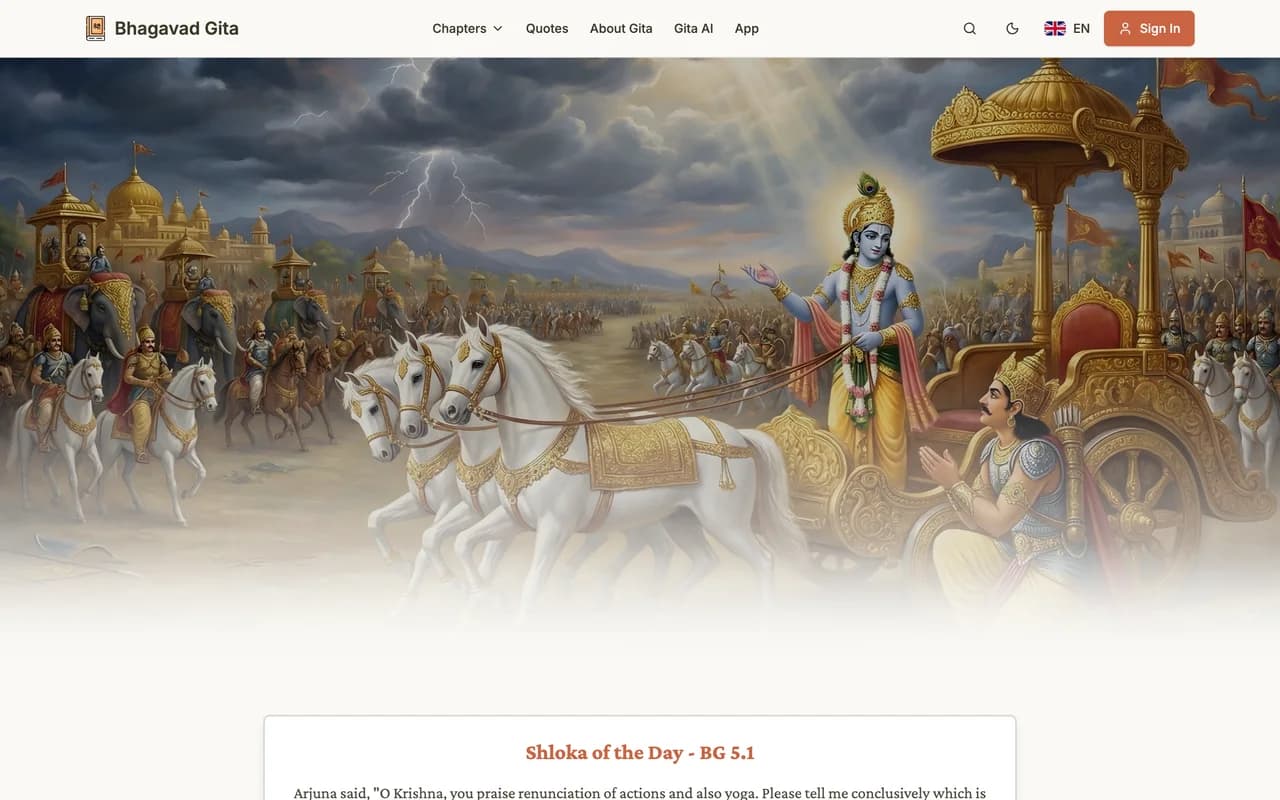
The BhagavadGita.com home page, showing Krishna and Arjuna on the battlefield of Kurukshetra